Educational content only. Not financial advice. Always do your own research. See full Disclaimer.
Risk management position sizing is the quiet skill that decides whether you're still trading a year from now or whether your account is a smoking crater. Most beginners pour all their energy into finding the perfect stock to buy. But the traders who actually last don't usually have some magic stock-picking gift. They just refuse to lose more than they can afford on any single trade. This guide walks you through it in plain English: how to size your positions, how the 1-2% rule works, how to use stop-losses, how to weigh risk against reward, and how to write a simple plan you'll actually follow.
Why protecting capital matters more than picking winners
Here's something that surprises almost every beginner. You can be right less than half the time and still come out ahead. And you can be right most of the time and still go broke. What makes the difference is how much you lose when you're wrong. Trading is a survival game first and a profit game second. Blow up your account and you're out, no matter how brilliant your next idea might have been.
The math is brutal, and it's worth committing to memory. Lose 50% of your account and you don't need a 50% gain to get back to even, you need 100%. A 90% loss requires a 900% gain just to break even. Small losses are recoverable. Large ones compound against you. That's exactly why defense is the foundation you build everything else on.
Amateurs think about how much they can make. Professionals think about how much they can lose.
Once you accept that protecting your capital is job number one, every other decision gets calmer and clearer: what to buy, how much, when to sell. You stop chasing and start managing.
Position sizing: deciding how much to put into one trade
Position sizing just means deciding how many shares (or contracts) to buy so that a single trade can't do real damage. It's easily the most underrated skill in trading. A great idea with a reckless position size is a bad trade. A mediocre idea with a disciplined position size is at least survivable.
The beginner mistake is to think in dollars of investment ("I'll put $2,000 into this stock") instead of dollars of risk ("I'm willing to lose $40 if I'm wrong"). Those are two completely different questions. Position sizing for beginners flips the order. You decide your risk first, then work backwards to figure out how many shares that allows.
The simple formula
The whole thing fits on one line:
- Shares to buy = (Dollars you'll risk) ÷ (Distance from entry to your stop-loss)
Say you're willing to risk $100 on a trade. You plan to buy a stock at $50 and set a stop-loss at $45, so that's $5 of risk per share. Divide it out: $100 ÷ $5 = 20 shares. You buy 20 shares. If the stock hits your stop, you lose roughly $100, which is exactly what you planned for. The size of the position fell out of the risk, not out of a gut feeling.
The 1-2% rule: capping how much you risk per position
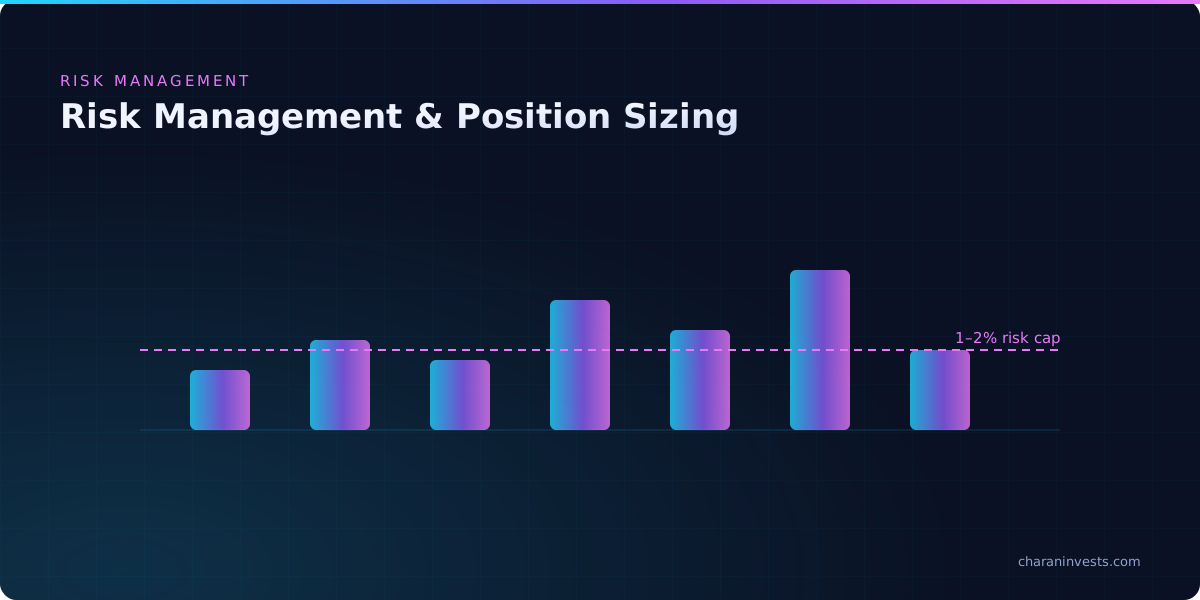
So how big should "dollars you'll risk" actually be? This is where the risk per trade rule earns its keep. The classic guideline is to risk no more than 1-2% of your total account on any single trade. On a $5,000 account, that's $50 to $100 of risk per position. Not $50 to $100 invested, but $50 to $100 lost if the trade goes against you and hits your stop.
Why keep it so small? Because it makes a losing streak survivable. Even the best traders hit cold runs of five, eight, ten losers in a row. Risk 2% each time and ten straight losses dent your account by roughly 18-20%. That stings, but you're very much still in the game. Risk 20% per trade instead, and three bad calls nearly wipe you out.
- Conservative beginners: risk 1% or less per trade while you're still learning.
- More experienced: up to 2% on higher-conviction setups, and rarely more.
- Never let one trade threaten a double-digit percentage of your account.
This single rule keeps more beginners alive than any chart pattern ever will. It quietly removes the "one bad trade ruins everything" scenario that ends most trading journeys before they even get going.
Stop-losses: pre-deciding your exit before emotions take over
A stop-loss is a price you decide on in advance, the point where you'll exit a losing trade, no questions asked. It's the tool that turns "I'm willing to risk $100" from a wish into a rule. Without one, "I'll just sell if it drops" quietly becomes "maybe it'll bounce back," which becomes a 40% loss you're now emotionally trapped in.
The whole point of a stop-loss is to make the call while you're calm, before any money is on the line, so your panicking future self doesn't get a vote. You can place a stop as an automatic order with your broker (this ties into the order types we cover in market orders vs. limit orders) or you can commit to a mental level and act on it with discipline.
Where to put a stop
A stop shouldn't be a random round number. Good stops sit at a level where your trade idea is genuinely wrong: below a support level, under a recent swing low, or past a point your analysis says shouldn't break. The tools in fundamental vs. technical analysis help you spot those levels. Set the stop too tight and normal wiggles knock you out. Set it too wide and you risk more than you meant to. That stop distance then feeds straight back into your position size.
Risk/reward ratio: is the trade even worth taking?
Before you enter, ask one simple question: how much can I make versus how much can I lose? That comparison is your risk/reward ratio. Risk $1 to potentially make $1 and you've got a 1:1 ratio, which means you'd have to win more than half your trades just to break even after costs. Risk $1 to make $3 (a 1:3 ratio) and you can be wrong most of the time and still walk away ahead.
Real numbers make the point stick:
- Risk $100 to make $300 on each trade (1:3 reward).
- Take 10 trades. Lose 6, win 4.
- Losses: 6 × $100 = -$600. Wins: 4 × $300 = +$1,200.
- Net result: +$600, and that's on a 40% win rate.
This is the secret hiding in plain sight. With a favorable risk/reward ratio, you don't need to be right often. You just need your winners to be meaningfully bigger than your losers. A common beginner-friendly minimum is to only take trades offering at least 1:2, so you risk one to make two. If a setup can't clear that bar, the disciplined move is usually to skip it.
Diversification's role in managing risk (and its limits)
Diversification means not dumping all your money into one stock, one sector, or one bet. The logic is intuitive. Own ten different things and if one collapses, you're hurt but not destroyed. Spreading risk across positions smooths out the bumps and shields you from a single company's bad news.
But diversification has real limits that beginners often miss:
- Over-diversifying into 50 random stocks just hands you a worse, more expensive version of an index fund.
- Fake diversification, like owning ten tech stocks, isn't really diversification at all. They tend to fall together.
- In a broad market crash (a bear market), most stocks drop together, so diversification alone won't save you.
Diversification is one layer of defense, not a full strategy. It works best alongside position sizing and stop-losses, not as a substitute for them. Managing risk in trading is about stacking several modest protections rather than leaning on a single silver bullet.
Why leverage and options demand even stricter risk rules
Everything above matters more, not less, the moment you add leverage. Leverage means controlling a bigger position than your cash alone would allow, which magnifies both gains and losses. Options are a common form of leverage. A small premium can control a much larger amount of stock, and that same option can lose 100% of its value fast, sometimes in a single day.
That asymmetry is exactly why leveraged instruments demand stricter rules. With options, your defined risk is often the entire premium you paid, so position sizing means deciding how much premium you can afford to lose to zero, then sizing as if it will. The 1-2% rule still applies. It just bites harder, because the swings are bigger and faster.
If you're exploring options or any kind of leverage, treat your risk plan as non-negotiable and read the full disclaimer first. The traders who survive options aren't the ones swinging for the fences. They're the ones who size small enough that one bad week is an inconvenience, not an extinction event.
Building a simple personal risk plan you'll actually follow
A risk plan you don't follow is worthless, so keep it short enough to remember. Write it on a sticky note if that's what it takes. A solid beginner plan answers four questions before you ever click buy:
- Max risk per trade: "I will never risk more than 1% of my account on one position."
- Stop-loss: "I set a stop before I enter, at the level where my idea is wrong."
- Position size: "I calculate shares from my risk and stop distance, never the other way around."
- Risk/reward minimum: "I only take trades offering at least 1:2."
Add one more rule that saves countless beginners: a daily or weekly loss limit. If you're down a set amount, you stop trading for the day. This protects you from the emotional spiral of revenge trading, where you chase losses with bigger, sloppier bets. The plan's whole job is to take decisions out of the hands of your in-the-moment, adrenaline-soaked brain.
You don't have to figure all this out alone. The Charan Invests community is a free Discord of 33,000+ beginner investors learning this exact discipline together, sharing plans, talking through stops, and keeping each other honest about position sizes. Watching how other beginners size their trades is one of the fastest ways to make these habits stick.
Keep learning
Risk management clicks faster when you watch it worked through visually. For a beginner-friendly walkthrough, search "risk management and position sizing for beginners" and watch a couple of explainers until the position-size formula feels automatic.
None of this is exciting. There's no thrill in capping a trade at 1% or passing on a setup that doesn't offer enough reward. But boring is the whole point. Boring is what keeps your account alive long enough for your good ideas to pay off. Get your defense right first, and offense gets a lot easier.
This article is educational content only and is not financial advice. Investing involves risk, including the possible loss of capital.
Frequently Asked Questions
The 1-2% rule says you should risk no more than 1% to 2% of your total account on any single trade. On a $5,000 account, that means risking $50 to $100 per position, meaning the amount you'd lose if the trade hit your stop-loss, not the amount you invest. The rule keeps a normal losing streak from doing serious damage to your account.
Instead of thinking in dollars invested, decide how much you're willing to lose first, ideally 1% or less of your account while you're learning. Then size the position from that risk and your stop-loss distance using the formula: shares = dollars risked ÷ (entry price minus stop price). This way the position size comes out of your risk tolerance, not a gut feeling.
A stop-loss is a price you decide on in advance, the point where you'll exit a losing trade, no questions asked. Set it at a level where your trade idea is genuinely wrong, like below a support level or a recent swing low, rather than at a random round number. A stop that's too tight gets triggered by normal price wiggles, while one that's too wide risks more than you intended.
A common beginner-friendly minimum is at least 1:2, so you risk one dollar to potentially make two. With a favorable risk/reward ratio you don't need to win often. Risking $100 to make $300 means you can lose 6 of 10 trades and still come out ahead. If a setup doesn't offer at least 1:2, the disciplined choice is usually to skip it.
Options are a form of leverage, meaning a small premium controls a much larger amount of stock and can lose 100% of its value quickly, sometimes in a single day. That speed and asymmetry make position sizing and the 1-2% rule more important, not less. With options, you generally size based on the premium you can afford to lose entirely.
Apply it live
Learn with 33,000+ beginners
Every lesson gets discussed live in the free Discord. Bring your questions and learn from real market moves.
Join Free Discord →Explore VIP