
Educational content only. Not financial advice. Always do your own research. See full Disclaimer.
Learning how to buy your first stock feels scary right up until the second you actually do it, and then you kind of wonder what you were so worried about. This guide is for anyone who gets what a stock is but has never placed a real order. We'll go through the whole thing one step at a time: picking a brokerage, opening and verifying your account, adding money, looking up a stock by its ticker, and clicking Buy without staring at the screen for ten minutes. By the end you'll know what every field is asking and what actually happens after the order goes through.
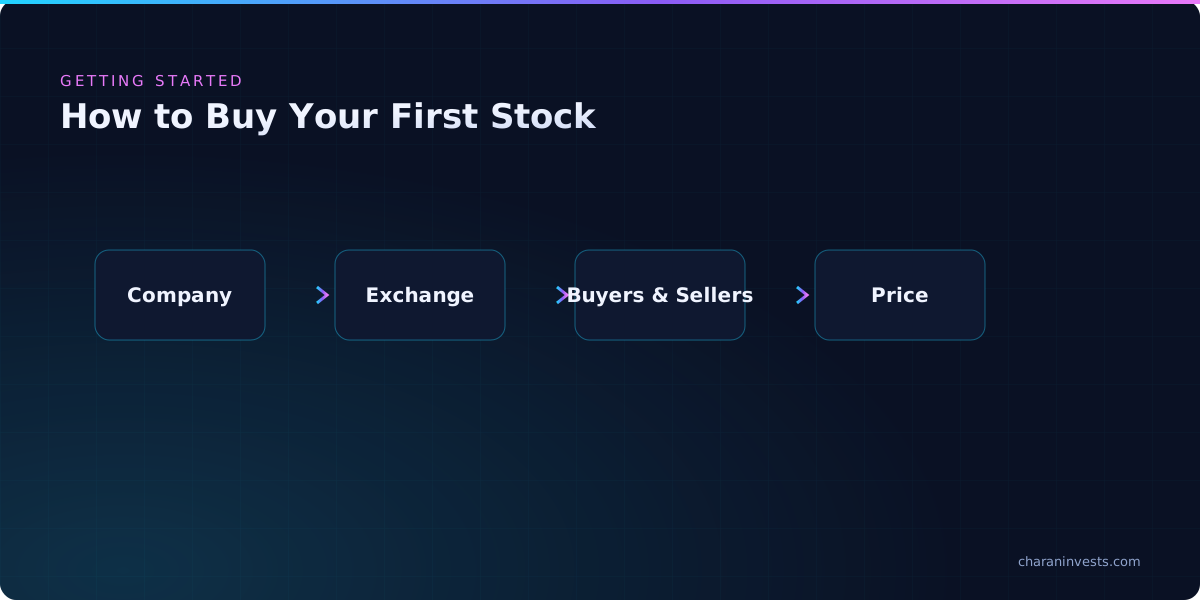
If you're still a little fuzzy on what you're buying, take two minutes and read what is a stock first. A share is a small piece of ownership in a real company, and that's the thing your order is going to drop into your account.
What a brokerage is and why you need one to buy stocks
You can't walk up to a company and hand over cash for shares. You buy and sell through a licensed middleman called a brokerage. So what is a brokerage account? Think of it like a bank account with a job. It holds your cash, sends your buy and sell orders to the stock exchanges, and keeps the shares you own. The brokerage handles all the wiring behind the scenes and keeps the official record of what's yours.
These days a brokerage is just an app or a website. You sign up, link a bank account, move some money over, and tap a few buttons to trade. Your shares sit there electronically in your name, so there's no paper certificate you can lose down the back of a drawer. The broker also sends you the tax paperwork you'll need every year, which is nice because you don't have to track it yourself.
A brokerage doesn't sell you stocks. It connects your order to a market full of other buyers and sellers.
How to choose a beginner-friendly broker (fees, fractional shares, app quality)
Picking the best broker for beginners is less about hunting for the one perfect option and more about not overthinking it. Almost all the big, well-known brokerages are safe, regulated, and totally fine for a first trade. What actually matters is whether a few features line up with how you want to start.
What's worth comparing
- Commissions: Most large US brokers charge $0 to trade stocks now. If one still wants a fee on a basic stock order, you can do better somewhere else.
- Fractional shares: This is the big one for beginners. Fractional investing lets you put in, say, $25 of a stock even when one full share costs $300. Your budget never boxes you out of a company you like.
- Account minimums: Go with a broker that lets you open an account with $0 so you can start tiny.
- App quality: You'll be in this app a lot, so a clean layout that makes the Buy screen obvious beats some flashy feature you'll never touch.
- Regulation and protection: Check that the broker is a member of FINRA and SIPC. SIPC protects your securities (up to certain limits) if the brokerage itself goes under. It does not protect you from a stock that simply drops in value.
Don't spend three weeks on this. A good-enough broker you use today beats the "perfect" one you're still researching next month. You can always open a second account later if you outgrow the first.
Step 1: Opening and verifying your brokerage account
Most of how to open a brokerage account is just having your info ready. Brokerages are financial institutions, so US law makes them confirm who you are before you can trade. Signing up usually takes 10 to 20 minutes.
Have these handy:
- Your Social Security number (or tax ID).
- A government-issued photo ID like a driver's license or passport.
- Your address, date of birth, and employment details.
- A bank account and routing number so you can fund it.
You'll also get a few questions about your income and investing experience. Answer honestly. It's not a test, it just helps the broker set sensible defaults for your account. After you submit, verification might be instant or take a day or two if they need to double-check something. For a first account, pick a standard individual taxable brokerage account unless you specifically want a retirement account like an IRA. Once you're approved, it's time to add money.
Step 2: Funding your account (and how much to start with)
Funding just means moving money from your bank into your brokerage. The usual way is a free electronic transfer (ACH). You link your bank, punch in an amount, and the cash normally lands in one to three business days. Some brokers even let you start trading against a small pending deposit right away.
How much should you start with?
Less than you'd guess. The right first amount is one you can afford to leave alone, and honestly one you could watch drop 20% without losing any sleep. For a lot of beginners that's somewhere between $50 and a few hundred dollars. Your first trade isn't about getting rich. It's about learning the buttons with real money on the line, just not much of it.
Your first trade is tuition, not a lottery ticket. Keep it small enough that the lesson stays cheap.
This is also a good moment to think about how much of your total money any one stock should be. Spreading your dollars across a few positions instead of dumping everything into a single name is the whole idea behind risk management and position sizing, and it's a habit worth starting from your very first buy.
Step 3: Finding a stock by its ticker symbol
Every publicly traded company has a short code called a ticker symbol, just a handful of letters you use to look it up and trade it. Apple trades as AAPL, Microsoft as MSFT, Coca-Cola as KO. Your broker's app has a search bar, so type the company name or the ticker and it'll pull up the stock's page.
On that page you'll see the current price, a chart, and a Buy button. Take a second to make sure it's the right company. Some names look alike, and the ticker is the one thing that's never ambiguous. If you're brand new, there's nothing wrong with starting on a big, familiar company you already understand as a customer instead of some hot tip you couldn't explain to a friend.
- Ticker: the official short code (for example, AAPL).
- Last price: the most recent price a share actually traded at.
- Bid/Ask: the highest price buyers will pay and the lowest price sellers will take right now.
Step 4: Placing your first order and what the buy screen is asking you
This is the part that makes people sweat, but the buy screen is really just asking a few plain questions. Here's what each field means.
The fields you'll see
- Buy or Sell: You're buying, so pick Buy.
- Quantity: How many shares you want, or with fractional investing, how many dollars.
- Order type: Usually a choice between a market order and a limit order. A market order buys right now at the best available price. A limit order only buys at a price you set or better. This one choice trips up a ton of beginners, so it's worth getting straight. Our post on market order vs limit order walks through the full difference.
- Time in force: How long the order stays live. "Day" means it expires at market close if it doesn't fill.
For a small buy of a large, heavily traded stock during market hours, a market order is simple and does the job. If you want price certainty, especially on a thinly traded or fast-moving stock, a limit order keeps you from paying more than you meant to. Keep in mind the US market runs 9:30am to 4:00pm ET on weekdays. Orders you place outside those hours either wait in line or route to extended-hours sessions, depending on your broker.
Once the fields look right, you'll get a review screen that sums up the order. Read it, confirm, and submit.
What happens after you hit 'Buy': settlement, confirmation, and your portfolio
The moment your order fills, you get a confirmation with the price and quantity, and the shares show up in your portfolio. Congrats, you now own a real piece of a real company.
Behind the scenes, the trade "settles," which is just the official transfer of shares and cash getting finalized a little after the trade. In the US the standard is one business day, usually written as T+1. You don't have to do a thing during settlement, it happens on its own. After that your position bounces up and down with the stock's price every trading day, and that's completely normal. A green or red number on day one tells you almost nothing about whether it was a smart move.
- Confirmation: proof of what you bought and at what price.
- Position: your holding, shown in the portfolio with its current value.
- Cost basis: what you paid, which matters later for taxes.
Common first-trade mistakes to avoid (and what to do next)
A handful of the same slip-ups catch almost everyone learning how to buy stocks for beginners. Knowing them ahead of time makes your first trade go a lot smoother.
- Going all-in on one stock. Start small and spread it out. Piling into a single name is how beginners get burned.
- Using a market order on a low-volume stock. The price can jump between the moment you tap Buy and the moment the order fills. When in doubt, use a limit order.
- Checking the price every five minutes. Day-one wiggles are noise. You bought a piece of a business, not a scratch ticket.
- Chasing hype. If you can't explain in one sentence why you own something, slow down and learn a bit more first.
- Forgetting it's a learning rep. The point of trade number one is to kill the mystery, not to make a fortune.
Your best next move is to keep learning alongside people doing the exact same thing. The free Charan Invests community is a Discord of 35,000+ beginner investors asking these questions out loud, which makes the whole thing feel a lot less lonely. When you're ready to dig into stuff like options and structured strategies later, the VIP program is there for it, but there's no rush at all. Buying your first share well is plenty for one day.
Keep learning
Want to watch the whole thing from start to finish? Search YouTube for "how to buy your first stock for beginners step by step" and follow along in your own broker's app as you go.
This article is educational content only and is not financial advice. Investing involves risk, including the possible loss of capital.
Frequently Asked Questions
Open an account with a regulated brokerage, verify your identity, and link your bank to fund it. Then search for a company by its ticker symbol, choose how many shares or dollars to buy, pick an order type, and confirm. Starting small with a company you already know is a sensible way to learn how it all works.
A brokerage account is a regulated account that holds your cash, places buy and sell orders on the stock exchanges, and stores the shares you own. Yes, you need one to buy stocks, since you can't purchase shares straight from a company. Most accounts open online for free in about 10 to 20 minutes.
Often very little. Plenty of brokers have no account minimum and offer fractional shares, so you can put in just a few dollars even on expensive stocks. A good first amount is one you can afford to leave invested and watch move around without stress, which for many beginners lands between $50 and a few hundred dollars.
A ticker symbol is a short code of letters that uniquely identifies a publicly traded company, like AAPL for Apple or MSFT for Microsoft. To find a stock, type the company name or ticker into your broker's search bar and it pulls up the stock's page with its price, chart, and a Buy button. Always check the ticker matches the company you mean to buy.
For a small buy of a large, heavily traded stock during market hours, a market order is simple and fills right away at the best available price. A limit order is better when you want price certainty or you're buying a thinly traded or fast-moving stock, because it only fills at your chosen price or better. Beginners who'd rather avoid surprises often stick with limit orders.
Apply it live
Learn with 35,000+ beginners
Every lesson gets discussed live in the free Discord. Bring your questions and learn from real market moves.
Join Free Discord →Explore VIP