Educational content only. Not financial advice. Always do your own research. See full Disclaimer.
If you've ever wanted to know how the stock market works but every explanation buried you in jargon, this one's for you. By the time you finish reading, you'll get what the stock market actually is, why prices move around all day, and how millions of buyers and sellers set the price of a company in real time. No finance degree needed.
The stock market sounds intimidating. But the core idea is something you already understand. It's a marketplace where people buy and sell, and prices move based on supply and demand. We'll build the full picture one piece at a time.
What "the stock market" really means
The stock market isn't a building, a casino, or a single thing that goes "up" or "down." It's a big, organised marketplace where people buy and sell small pieces of companies, called shares. So when you hear "the market was up today," it just means the combined value of those companies' shares rose on average.
You will also hear it called the share market, which is the exact same thing. That name is common in India, the UK, and much of the world, since what you are really trading are shares. Whether someone says stock market or share market, they mean this same marketplace, and everything below applies either way.
Picture a farmers' market. Except instead of trading apples and bread, people are trading ownership in businesses like Apple, Nike, or Tesla. The prices change constantly, which is exactly what you'd expect when lots of buyers and sellers are haggling in real time.
Companies, shares, and why businesses sell ownership
When a company wants to grow (build factories, hire people, launch products) it needs money. One way to raise it is to sell small slices of ownership to the public. Each slice is a share. Sell a million shares and you've just raised money from a million potential owners.
In return, the people who bought those shares now own a tiny piece of the business. If the company does well, their slice becomes worth more. We get into exactly what owning a share entitles you to in our guide on what a stock is.
Stock exchanges explained: the NYSE and the Nasdaq
A stock exchange is the organised venue where all this buying and selling actually happens. In the United States, the two biggest are the New York Stock Exchange (NYSE) and the Nasdaq. Their whole job is to match buyers with sellers quickly, fairly, and out in the open.
You never walk onto the exchange floor yourself. Instead you use a brokerage app that connects to the exchange on your behalf. There's more on that in how to buy your first stock.
How a stock price actually moves
This is the part most beginners get wrong. A stock's price isn't set by the company or by some authority up on high. It's set by a live, non-stop auction between buyers and sellers:
- More buyers than sellers? Buyers compete and bid the price up.
- More sellers than buyers? Sellers compete and the price drops.
That's really it. Every price you see is just the most recent price someone was willing to pay and someone else was willing to accept. News, earnings, and plain old emotion all matter, but only because they change how many people want to buy versus sell.
A stock's price is nothing more than the latest deal struck between a buyer and a seller.
What an index is (the S&P 500, Nasdaq, Dow)
You can't track thousands of stocks at once, so we lean on indexes. Think of them as baskets that measure a group of stocks together. The S&P 500 tracks 500 of the largest US companies. The Dow tracks 30 big names. The Nasdaq Composite leans heavily toward technology.
When someone says "the market is up 1%," they usually mean an index like the S&P 500 rose 1%. Indexes are how we take the overall temperature and direction of the market at a glance.
Investing vs. trading: two different games
People use the stock market in two pretty different ways:
- Investing is buying shares to hold for years, betting the business grows over time.
- Trading is buying and selling over shorter stretches (days or weeks) to profit from price moves.
Neither one is "better." They're different skills with different risks. Beginners almost always start by understanding investing first, then pick up trading carefully once they've got their footing. Getting the difference straight also helps you make sense of bull and bear markets and how to think in each.
Market hours and what "the market is open" means
The US stock market is open Monday to Friday, 9:30 a.m. to 4:00 p.m. Eastern Time, holidays excepted. Outside those hours, prices can still move in "pre-market" and "after-hours" sessions, just with fewer people trading and bigger swings. So when people say "the market is open," they're talking about those core trading hours when most of the buying and selling happens.
Your next step: from understanding to owning
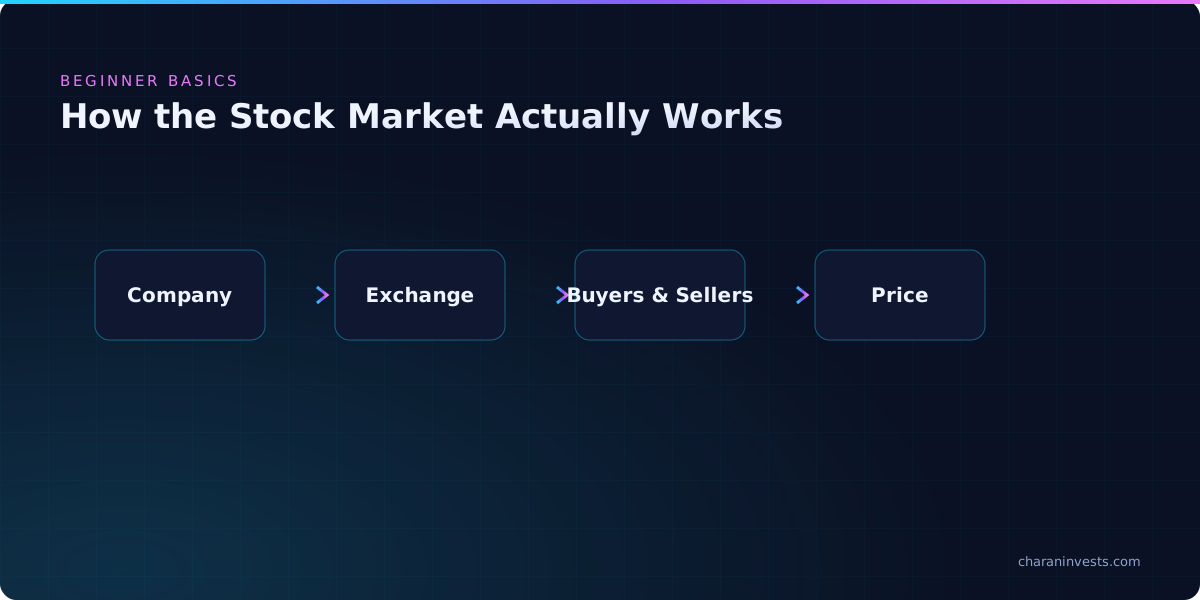
You now understand the engine. Companies sell shares, exchanges host the trading, and a live auction of buyers and sellers sets every single price. That mental model is the foundation everything else builds on.
The best way to make it stick is to keep learning alongside other beginners. Inside the Charan Invests community, 35,000+ new investors break down real market moves together every single day, so the theory you just picked up clicks into place with live examples. You can also read more about Charan's story and why this community exists.
Keep learning
Prefer to watch? Search YouTube for a beginner explainer like "how does the stock market work for beginners" to see the auction mechanism animated. It reinforces everything above.
This article is educational content only and is not financial advice. Investing involves risk, including the possible loss of capital.
Frequently Asked Questions
The stock market is a marketplace where people buy and sell small pieces of companies called shares. Prices move based on supply and demand. When more people want to buy a stock than sell it, the price rises, and when more want to sell than buy, it falls. Exchanges like the NYSE and Nasdaq match buyers with sellers in real time.
A stock's price is set by a live auction between buyers and sellers. If buyers outnumber sellers, they bid the price up. If sellers outnumber buyers, the price falls. News, earnings, and investor emotion move prices only because they change how many people want to buy versus sell.
A stock exchange is the organised venue where shares are bought and sold. In the US, the largest are the New York Stock Exchange (NYSE) and the Nasdaq. You reach an exchange through a brokerage app, which places your buy and sell orders for you.
Investing means buying shares to hold for years, betting the company grows over time. Trading means buying and selling over shorter periods like days or weeks to profit from price movements. They're different skills with different risk profiles, and beginners usually learn investing first.
The US stock market is open Monday to Friday, 9:30 a.m. to 4:00 p.m. Eastern Time, excluding holidays. Prices can also move during pre-market and after-hours sessions, though those have fewer participants and larger price swings.
Apply it live
Learn with 35,000+ beginners
Every lesson gets discussed live in the free Discord. Bring your questions and learn from real market moves.
Join Free Discord →Explore VIP